Alexander Majors, Russell Majors & Waddell, and the Pony Express
Alexander Majors is often credited with being one of the commercial forefathers of Kansas City. His companies created such a demand for cattle that it helped fuel the Kansas City stockyards and livestock exchange. His ventures allowed for the swift transfer of goods and information across the western United States at a time of great transition, as the United States grew to span the breadth of the North American continent.
Early Ventures
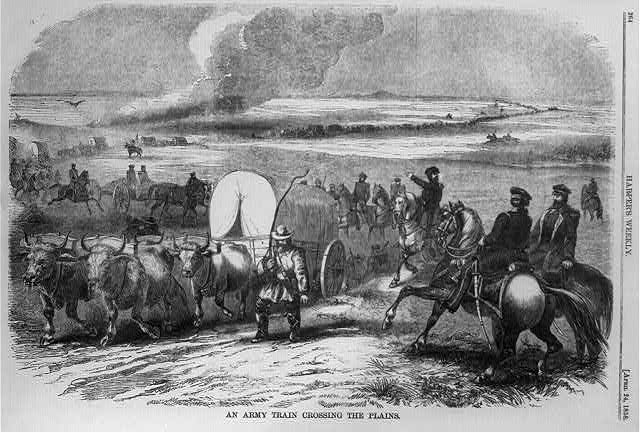
Alexander Majors came from a long line of farmers. But by 1846, Majors had six children with wife, Katherine Stalcup, four of them girls. (He would go on to have nine children with Katherine, and an additional three with his second wife, Susan.) He was eager to educate his daughters and bring them up as upper-class women, which he did not think possible on farming income alone. Based on his experience with handling animals, he decided he had the proper skills to enter the freighting business. His first trading expedition was to the Potawatomi tribal reservation near the Kansas River. His successful first trip, coupled with the Mexican-American War and American acquisition of new territories, led Majors to believe he could successfully take advantage of expanding trade opportunities in the West.
He officially started his freighting business in 1848, traveling to Santa Fe in a record 92 days. He obtained his first government contract in 1850, freighting from Fort Leavenworth to Fort Atkinson in the Kansas Territory.
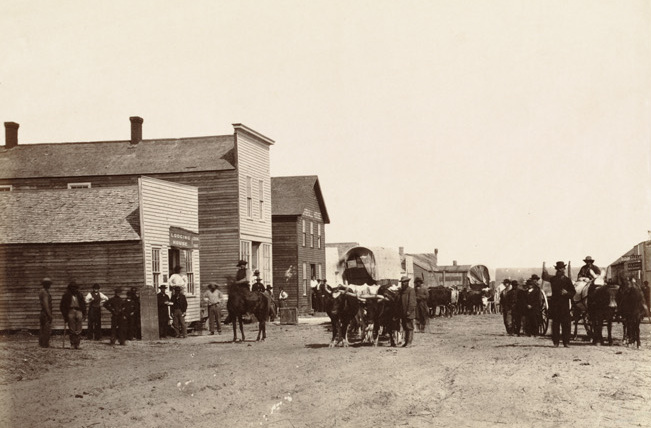
Images: Santa Fe-bound wagon train passing through Ellsworth, Kansas, 1867. Boston Public Library (right); Army train crossing the plains to Utah, Harper’s Weekly, 1858, Library of Congress cph 3b26059 (top).
Russell, Majors & Waddell
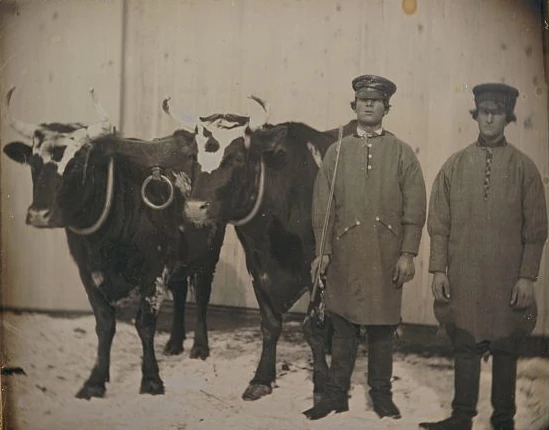
By 1855, Majors was so successful that he partnered with two of his former competitors, William Russell and William Waddell. Their firm grew to include 3,500 wagons and 40,000 oxen. By 1857, the men held a virtual monopoly on government freighting west of the Mississippi River.
Majors had a hands-on role in the company, managing the employees and wagon train logistics. He was a deeply religious man, which informed the way that he did business. Majors required that his employees sign an oath promising not to drink, swear, treat animals cruelly, or behave in any way “unbecoming of a gentleman.” He also gave all employees a copy of the Bible and enforced a day of rest on Sundays, at a time when most freighters did not observe a weekend. Majors was interested in the morality of his men, but he also realized that sober, well-mannered, and rested men would make for the most productive workers.
The success of Majors and his partners was deeply entwined with their status as slaveholders, and the firm was known for its pro-slavery stance during the Bleeding Kansas period. The men relied on slave labor in their businesses, and they had a personal and professional interest in making slavery legal in Kansas. The men, particularly Russell, used their influence to assist the pro-slavery cause, including engaging in land speculation and firing Free State employees. However, Majors was also a Unionist and required his employees to swear loyalty to the United States during the Civil War.
Image: Pair of oxen and their drovers, 1848, Library of Congress cph 3g12383
The Pony Express
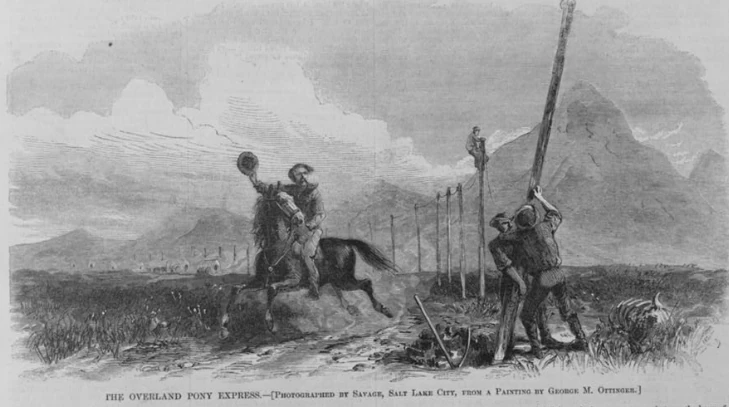
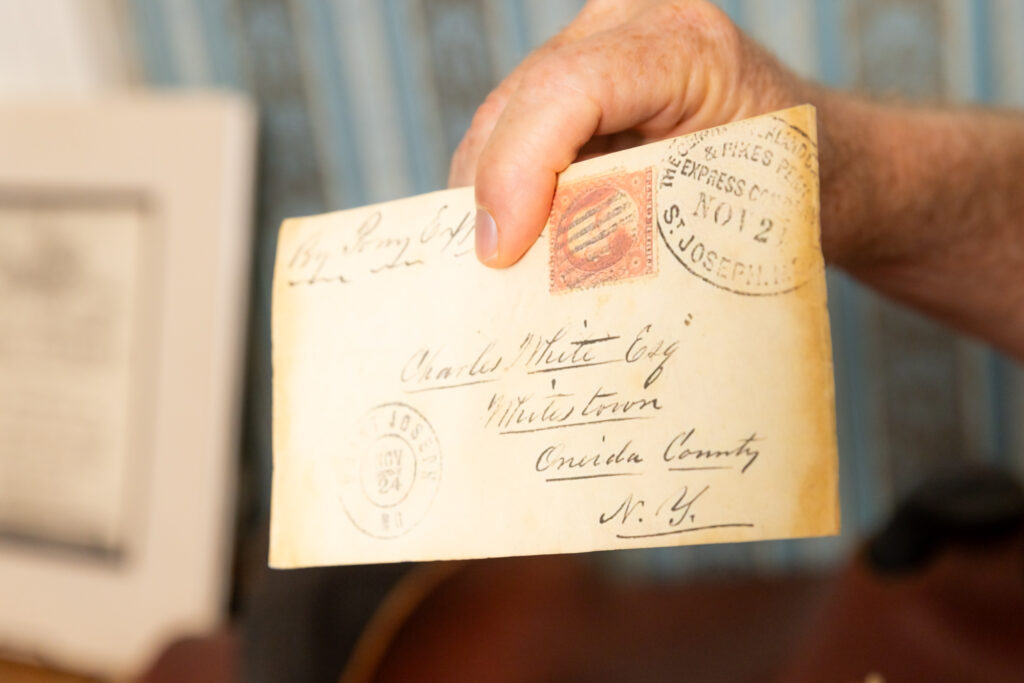
After meetings with California Senator William Gwin in January 1860, Russell announced this intention to create the Pony Express, a fast mail service linking the eastern and western United States. Majors and Waddell initially refused, believing it would not make money, but eventually agreed to the undertaking. The first Pony Express rider departed St. Joseph, Missouri, on April 3, 1860. The message arrived in Sacramento, California, on April 14.
Ultimately, the Pony Express only lasted 18 months. Advances in technology, such as the telegraph and transcontinental railroad, put the Pony Express out of business. Russell Majors and Waddell also began to flounder due to Russell’s failed ventures and his subsequent embroilment in an embezzlement scandal. In January 1861, the business went bankrupt, and the last Pony Express message was delivered on October 26 of that year.
Image: Martial Law/Order No. 11, George Caleb Bingham, 1868.
Support These Stories
Help Wornall/Majors make history accessible and preserve two Kansas City landmarks.